
AdvanceBio SEC
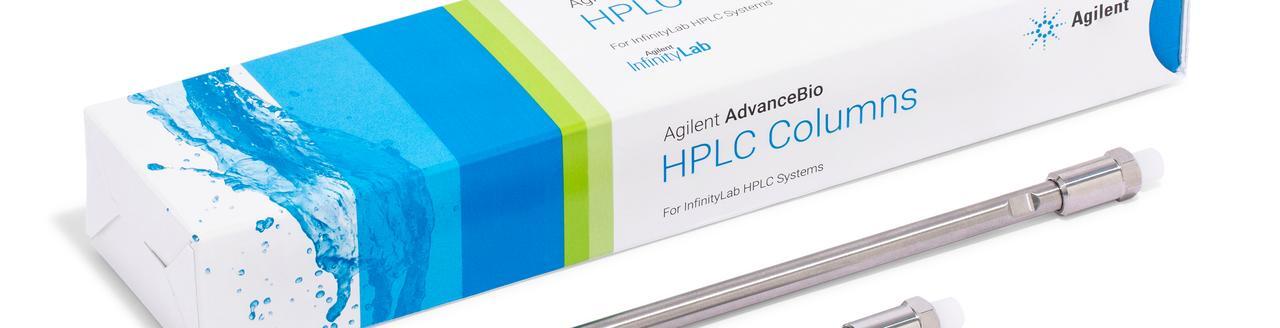
Agilent AdvanceBio SEC HPLC Bio Columns
Agilent AdvanceBio SEC (Size Exclusion Chromatography) columns are engineered to deliver highly accurate, reproducible quantitation of aggregates and fragments in peptides, monoclonal antibodies (mAbs), ADCs, and next-generation biotherapeutics. Designed to eliminate re-analysis and improve lab productivity, these columns offer unmatched consistency—column to column, batch to batch, and lab to lab—ensuring seamless method transfer across teams and sites.
Built on a unique hydrophilic, non-interacting surface technology, AdvanceBio SEC columns minimize secondary interactions—even with “sticky” biomolecules—providing clean, reliable molecular-size separations. This makes them an ideal choice for quality control, formulation studies, biosimilar development, and characterization of large, fragile biological entities.
AdvanceBio SEC 2.7 µm Columns
These robust columns are optimized for routine aggregate and fragment analysis of proteins and peptides. Originally offered in 300 Å and 130 Å pore sizes, they deliver sensitive, reliable results with minimal interaction between sample and stationary phase. New 500 Å and 1000 Å options extend the platform to support AAVs, VLPs, and other large biomolecular assemblies, enabling high-resolution characterization of emerging biotherapeutic modalities.
AdvanceBio SEC 1.9 µm Columns
For laboratories requiring maximum resolution and speed, the 1.9 µm series provides UHPLC-level efficiency. Stability up to 620 bar enables faster flow rates and higher throughput, while the 200 Å pore size is specifically designed for detailed mAb profiling—resolving monomer, dimer, and low-level fragments with exceptional clarity.
Whether you are characterizing traditional biologics or next-generation gene therapy products, Agilent AdvanceBio SEC columns deliver the reliability, robustness, and resolution needed for confident, regulatory-ready biomolecular analysis.
Agilent AdvanceBio SEC columns are engineered for high-resolution size-based separation of proteins, monoclonal antibodies (mAbs), aggregates, and biotherapeutics under native or near-native conditions. Unlike reversed-phase columns, SEC separates molecules strictly by hydrodynamic size, minimizing secondary interactions.
- You need accurate quantitation of protein aggregates and fragments
- You are performing mAb purity or stability studies
- You require non-denaturing conditions for intact biomolecules
- You need reproducible sizing with minimal adsorption
Molecules are separated by their ability to penetrate porous particles. Larger molecules are excluded from the pores and elute first, while smaller species access more pore volume and elute later. The hydrophilic diol surface reduces unwanted protein–surface interactions, improving recovery and peak symmetry.
| Separation Mode | Size Exclusion Chromatography (SEC) |
| Surface Chemistry | Hydrophilic, diol-bonded silica |
| Pore Sizes Available | Typically 130 Å (peptides/small proteins) and 300 Å (mAbs/large proteins) |
| Mobile Phase | Aqueous buffers (e.g., phosphate or saline-based) |
| Primary Applications | Aggregate analysis, fragment analysis, biosimilar comparison, protein purity testing |
| Interaction Mechanism | Size-based exclusion (minimal secondary interactions) |
Practical note: For optimal accuracy in aggregate quantitation, maintain appropriate ionic strength in the mobile phase to suppress unintended ionic interactions.
Product List
| SKU | Name | LC Column Phase | Pore Size | Inner Diameter (ID) | Length |
|---|---|---|---|---|---|
SKU
PL1180-5302
|
Name
PL1180-5302 - AdvanceBio SEC 1000 A, 2.7 um, 7.8 x 300
|
LC Column Phase
SEC
|
Pore Size
1000 A
|
Inner Diameter (ID)
7.8 mm
|
Length
300 mm
|
SKU
PL1180-5325
|
Name
PL1180-5325 - AdvanceBio SEC 500 A, 2.7 um, 7.8 x 300
|
LC Column Phase
SEC
|
Pore Size
500 A
|
Inner Diameter (ID)
7.8 mm
|
Length
300 mm
|
SKU
PL1180-1302
|
Name
PL1180-1302 - AdvanceBioSEC 1000 A, 2.7 um, 7.8x50mm, guard
|
LC Column Phase
SEC
|
Pore Size
1000 A
|
Inner Diameter (ID)
7.8 mm
|
Length
50 mm
|
SKU
PL1180-1325
|
Name
PL1180-1325 - AdvanceBio SEC 500 A, 2.7 um, 7.8x50mm, guard
|
LC Column Phase
SEC
|
Pore Size
500 A
|
Inner Diameter (ID)
7.8 mm
|
Length
50 mm
|
SKU
PL1580-5302
|
Name
PL1580-5302 - AdvanceBio SEC 1000 A, 2.7 um, 4.6x300mm
|
LC Column Phase
SEC
|
Pore Size
1000 A
|
Inner Diameter (ID)
4.6 mm
|
Length
300 mm
|
SKU
PL1580-5325
|
Name
PL1580-5325 - AdvanceBio SEC 500 A, 2.7 um, 4.6x300mm
|
LC Column Phase
SEC
|
Pore Size
500 A
|
Inner Diameter (ID)
4.6 mm
|
Length
300 mm
|
SKU
PL1580-3302
|
Name
PL1580-3302 - AdvanceBio SEC 1000 A, 2.7 um, 4.6x150mm
|
LC Column Phase
SEC
|
Pore Size
1000 A
|
Inner Diameter (ID)
4.6 mm
|
Length
150 mm
|
SKU
PL1580-3325
|
Name
PL1580-3325 - AdvanceBio SEC 500 A, 2.7 um, 4.6x150mm
|
LC Column Phase
SEC
|
Pore Size
500 A
|
Inner Diameter (ID)
4.6 mm
|
Length
150 mm
|
SKU
PL1580-1302
|
Name
PL1580-1302 - AdvanceBioSEC 1000 A, 2.7 um, 4.6x50mm, guard
|
LC Column Phase
SEC
|
Pore Size
1000 A
|
Inner Diameter (ID)
4.6 mm
|
Length
50 mm
|
SKU
PL1580-1325
|
Name
PL1580-1325 - AdvanceBio SEC 500 A, 2.7 um, 4.6x50mm, guard
|
LC Column Phase
SEC
|
Pore Size
500 A
|
Inner Diameter (ID)
4.6 mm
|
Length
50 mm
|
SKU
PL1580-5350
|
Name
PL1580-5350 - Zorbax AdvanceBio SEC 130A 2.7um 4.6x300mm
|
LC Column Phase
SEC
|
Pore Size
130 A
|
Inner Diameter (ID)
4.6 mm
|
Length
300 mm
|
SKU
PL1580-5301
|
Name
PL1580-5301 - Zorbax AdvanceBio SEC 300A 2.7um 4.6x300mm
|
LC Column Phase
SEC
|
Pore Size
300 A
|
Inner Diameter (ID)
4.6 mm
|
Length
300 mm
|