

Autosampler Vial Septa: How to Choose for Solvent Compatibility
When performing LC (Liquid Chromatography) or GC (Gas Chromatography) analyses, it’s important to store and transport samples in the right type of vial. Chromatography vials come in a variety of shapes, sizes, and closure styles—each designed for specific applications. If you’re unsure where to start, our autosampler vial selection guide covers vial types in detail.
In this knowledge page, we’ll focus on another critical factor: the septa material used in vial caps. Septa selection directly impacts sealing integrity, solvent compatibility, and background noise in your analysis.
Step 1: Choose Septa Based on LC vs. GC Requirements
- LC / HPLC / LCMS: Often prioritize resealability and repeat injections with screw thread closures.
- GC: Often prioritizes a tighter seal for volatile samples and heated injection cycles using crimp closures.
- Storage: Often prioritizes maximum long-term seal integrity and repeated opening/closing performance.
Common Septa for LC (HPLC / LCMS) Vials
In liquid chromatography, screw thread vials and closures are most commonly used. The standard septa material is a PTFE/Silicone (PTFE/Sil) combination, known for resealability and solvent resistance—making it ideal for multiple injections.
Some PTFE/Sil septa include a pre-slit design, which helps prevent vial lift-off when the autosampler needle withdraws and can support repeated injections in high-throughput workflows.
For laboratories seeking a more economical choice, polyethylene (PE) septa are a popular option, often used with snap seal vials and closures in LC and LCMS workflows. These provide a sufficient seal for general liquid chromatography applications at a lower cost.
- Default for LC/HPLC/LCMS: PTFE/Silicone (resealable, solvent resistant)
- High-throughput / repeated injections: Consider pre-slit PTFE/Silicone
- Budget / general LC: PE septa (often with snap seal closures)
Common Septa for GC Vials
In gas chromatography (GC), sample volatility demands a tighter, more secure seal to prevent evaporation and contamination. For this reason, crimp-style closures with aluminum caps are most common.
These are typically paired with PTFE/Silicone septa, combining the inertness of PTFE with the flexibility and compression strength of rubber to help maintain a leak-free seal during injection and heating cycles.
- Default for GC: Crimp closures + PTFE/Silicone septa (tight seal, volatility control)
- Leak prevention priority: Ensure consistent crimping and compression strength
Minimizing Background Noise from Septa
High-sensitivity applications, such as trace analysis or mass spectrometry, can be affected by background interference from septa materials. Chrom Tech offers specialized septa options to help minimize background noise:
- Seal 2000 Silica Septa: A specially formulated silica rubber compound designed to reduce background noise and prevent bleed in GC applications.
- Mass Spec Quality (MSQ) Septa: Used primarily with screw thread closures; often paired with low-adsorption vials to achieve near-zero background interference in LCMS workflows.
For applications such as PFAS analysis, using PTFE-free consumables is essential. Because PTFE-lined septa can contribute to contamination, we recommend using polypropylene snap top vials with PE septa for a PTFE-free workflow.
- LCMS low background: MSQ septa + low-adsorption vials
- GC low bleed: Seal 2000 septa
- PFAS: Avoid PTFE-lined septa; use polypropylene vials + PE septa
Storage Vials and PTFE/F217 Septa (Solid-Top Caps)
For long-term sample storage, vials with solid-top caps are often lined with PTFE/F217 foam. F217 is a polyolefin foam core sandwiched between two polyethylene layers, providing strong resealability after multiple openings.
When torqued down to approximately 20 lbs of pressure, the liner compresses to form a tight seal, then rebounds almost fully when released. This makes PTFE/F217-lined caps ideal for sample storage and standards preparation.
Solvent Compatibility: What to Verify Before Use
Most standard septa materials are compatible with typical chromatography solvents, but it’s still important to verify solvent compatibility before use—especially with aggressive solvents, long storage times, or trace analysis workflows.
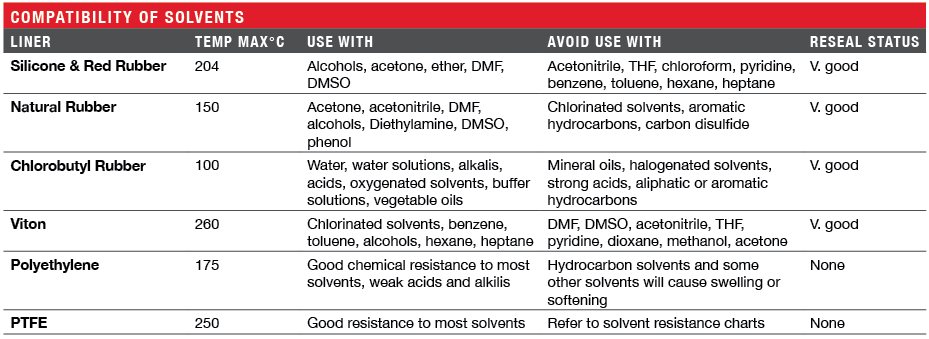
- Confirm your solvent class (polar, nonpolar, chlorinated, aromatic, etc.)
- Consider temperature exposure (especially GC injection conditions)
- Consider storage duration (short-run injections vs. long-term standards storage)
- Confirm whether PTFE must be avoided (PFAS workflows)
Conclusion
Choosing the correct septa material is crucial for maintaining sample integrity, reducing background noise, and ensuring reproducible results in both LC and GC applications. Chrom Tech offers a wide range of vials, closures, and septa for all analytical workflows.
If you need help selecting the best septum and vial combination for your analytical and regulatory requirements, contact our product specialists.
Ready to explore all vial types? Visit our Chromatography Vials resource center to compare HPLC, GC, and headspace options in one place.