
Poroshell Peptide Mapping
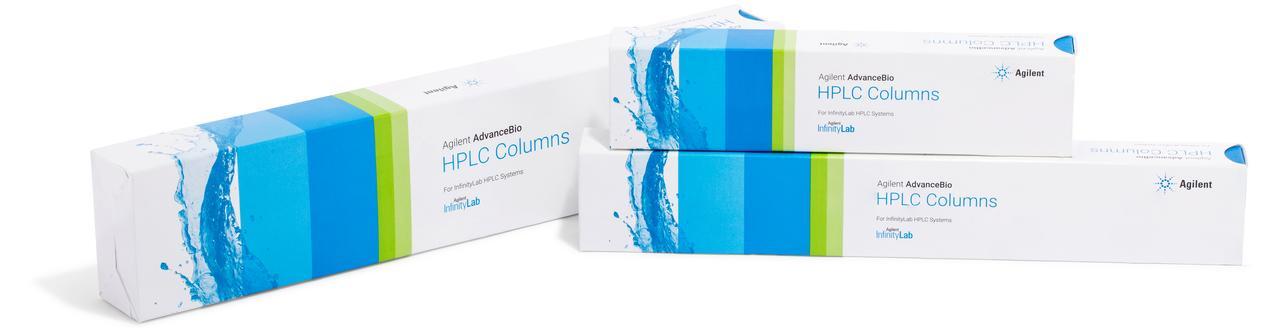
Agilent InfinityLab Poroshell 120 AdvanceBio Peptide Mapping
The InfinityLab Poroshell 120 AdvanceBio Peptide Mapping columns are purpose-built for high-confidence peptide mapping, sequence confirmation, and post-translational modification (PTM) analysis. Engineered with 2.7 µm superficially porous particles and optimized bonded phases, these columns deliver outstanding resolution, sharper peaks, and improved sensitivity for complex peptide mixtures.
Every batch of AdvanceBio Peptide Mapping media is QA-tested with a rigorous multi-peptide standard, ensuring consistent selectivity, retention, and chromatographic performance across lots. This guarantees reliable identification of key peptides—critical for biopharmaceutical characterization, biosimilar comparison, and QC workflows.
Designed for robustness and ease of use, Poroshell 120 AdvanceBio columns provide fast, reproducible separations with lower backpressure, enabling compatibility with both traditional HPLC and modern UHPLC systems. Their high efficiency makes them ideal for workflows such as peptide mapping, PTM profiling, peptide impurity analysis, and biomarker discovery.
Whether optimizing a regulated biopharma method or developing new analytical workflows, Agilent InfinityLab Poroshell 120 AdvanceBio Peptide Mapping columns offer the performance, reproducibility, and confidence required for today’s complex peptide analyses.
Poroshell 120 AdvanceBio Peptide Mapping C18 is engineered for high-resolution reversed-phase separations of enzymatically digested peptides. Built on Agilent’s solid-core (SPP) particle platform, it delivers UHPLC-level efficiency with manageable backpressure—ideal for peptide mapping workflows in biopharmaceutical development and QC.
- Tryptic peptide mapping of monoclonal antibodies
- Sequence confirmation and PTM analysis
- LC/MS-based peptide characterization
- High-coverage, high-resolution gradient separations
Compared to conventional fully porous 3–5 µm C18 columns, the Poroshell 120 SPP design improves peak capacity and reduces diffusion broadening—critical for resolving complex peptide mixtures. It enables faster cycle times without sacrificing resolution.
| Separation Mode | Reversed Phase (C18) |
| Particle Technology | Superficially Porous Particle (SPP / solid-core) |
| Pore Size | 120 Å |
| Application Focus | Peptide mapping & protein digest analysis |
| Detection Compatibility | UV, FLD, LC/MS |
| Typical Workflow | Tryptic digests of mAbs and recombinant proteins |
Product List
| SKU | Name | LC Column Phase | Particle Size | Inner Diameter (ID) | Length |
|---|---|---|---|---|---|
SKU
863600-911
|
Name
863600-911 - AdvanceBio Peptide Mapping, 1.0 x 150 mm
|
LC Column Phase
C18
|
Particle Size
2.7 um
|
Inner Diameter (ID)
1 mm
|
Length
150 mm
|
SKU
655950-302
|
Name
655950-302 - AdvanceBio, Peptide Mapping, 3.0 mm, 100 mm, 2.7 um column
|
LC Column Phase
C18
|
Particle Size
2.7 um
|
Inner Diameter (ID)
3 mm
|
Length
100 mm
|
SKU
5065-9946
|
Name
5065-9946 - AdvanceBio Peptide Mapping, 0.3 x 50mm, 2.7um
|
LC Column Phase
C18
|
Particle Size
2.7 um
|
Inner Diameter (ID)
0.3 mm
|
Length
50 mm
|
SKU
5065-9925
|
Name
5065-9925 - AdvanceBio Peptide Mapping, 0.075x150mm
|
LC Column Phase
C18
|
Particle Size
2.7 um
|
Inner Diameter (ID)
0.075 mm
|
Length
150 mm
|
SKU
850750-911
|
Name
850750-911 - Bio-C Peptide Map, 4.6 mm Guard
|
LC Column Phase
C18
|
Particle Size
2.7 um
|
Inner Diameter (ID)
4.6 mm
|
Length
5 mm
|
SKU
853750-911
|
Name
853750-911 - Bio-C Peptide Map, 3.0 mm Guard
|
LC Column Phase
C18
|
Particle Size
2.7 um
|
Inner Diameter (ID)
3 mm
|
Length
5 mm
|
SKU
851725-911
|
Name
851725-911 - Bio-C Peptide Map, 2.1 mm Guard
|
LC Column Phase
C18
|
Particle Size
2.7 um
|
Inner Diameter (ID)
2.1 mm
|
Length
5 mm
|
SKU
655750-902
|
Name
655750-902 - AdvanceBio Peptide Map, 2.1x100mm,2.7um
|
LC Column Phase
C18
|
Particle Size
2.7 um
|
Inner Diameter (ID)
2.1 mm
|
Length
100 mm
|
SKU
653950-902
|
Name
653950-902 - Bio-C Peptide Map, 4.6x150mm, 2.7um
|
LC Column Phase
C18
|
Particle Size
2.7 um
|
Inner Diameter (ID)
4.6 mm
|
Length
150 mm
|
SKU
653950-302
|
Name
653950-302 - Bio-C Peptide Map, 3.0x150mm, 2.7um
|
LC Column Phase
C18
|
Particle Size
2.7 um
|
Inner Diameter (ID)
3 mm
|
Length
150 mm
|
SKU
653750-902
|
Name
653750-902 - Bio-C Peptide Map, 2.1x150mm,2.7um
|
LC Column Phase
C18
|
Particle Size
2.7 um
|
Inner Diameter (ID)
2.1 mm
|
Length
150 mm
|
SKU
651750-902
|
Name
651750-902 - Bio-C Peptide Map, 2.1x250mm, 2.7um
|
LC Column Phase
C18
|
Particle Size
2.7 um
|
Inner Diameter (ID)
2.1 mm
|
Length
250 mm
|