Inline Check Valves
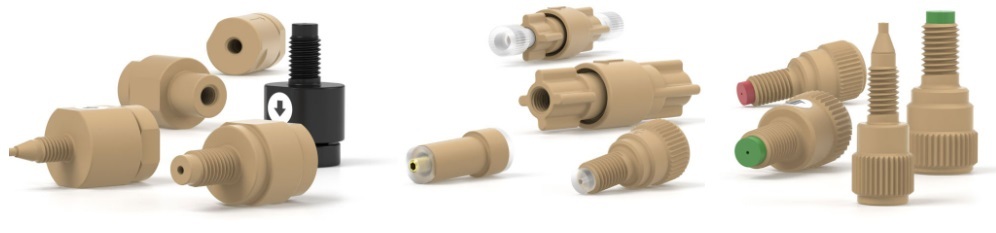
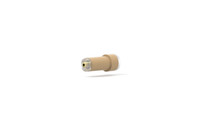
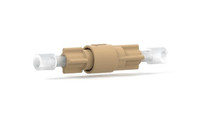
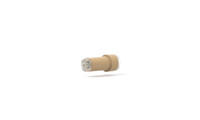
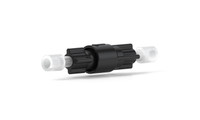
IDEX check valves provide reliable one-direction flow control for chromatography and laboratory fluid-handling systems. Designed to prevent backflow and protect sensitive upstream components, these valves are ideal for HPLC, UHPLC, microfluidics, post-column derivatization, and sample-delivery applications where consistent flow direction is critical.
Multiple configurations are available, including standard inline check valves, biocompatible non-metallic check valves, inline cartridge check valves, and Quick-Stop luer check valves. All designs deliver low cracking pressure to maintain stable flow while minimizing pressure loss. Most IDEX check valves connect directly to 1/4-28 flat-bottom ports, eliminating the additional tubing cuts and connections required by traditional inline check valves. They accept fittings for 1/32", 1/16", 1/8", and 1.0–3.0 mm OD tubing, allowing seamless integration into existing systems.
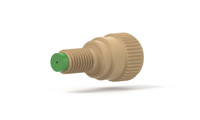
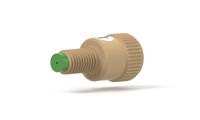
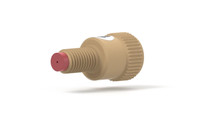
Standard Inline 1/4-28 Check Valves offer excellent chemical resistance and spring-actuated sealing to prevent backflow without added plumbing complexity. Non-Metallic Check Valves provide biocompatible flow paths with ultra-low swept volume (as little as 7.4 µL), making them ideal for lab-on-a-chip, single-cell analysis, and micro- or nano-LC workflows. Inline Cartridge Check Valves are commonly installed on the effluent side of columns to prevent post-column reagents from flowing backward and contaminating analytical columns during pump shutdowns.
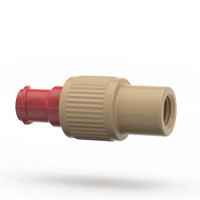
For applications requiring fast connect/disconnect convenience, the Quick-Stop Luer Inline Check Valve enables spill-free connections using standard 1/2-28 flat-bottom fittings, simplifying maintenance while reducing exposure to hazardous fluids.
Chrom Tech offers a broad selection of IDEX check valves and compatible fittings to support dependable backflow prevention, simplified installation, and optimized system performance. Many popular configurations are in stock and ready to ship.
| Part No | Description | Threads | Swept Vol | Thru-Hole | Max Pressure | Back Pressure | Cracking Pressure |
|---|---|---|---|---|---|---|---|
| STANDARD 1/4-28 INLINE CHECK VALVES | |||||||
| CV-3301 | Inlet | 1/4-28 FB, M to 1/4-28 FB, F | 20 µL | 0.020" (0.50 mm) | 2,000 PSI (138 bar) | 45 PSI (3.1 bar) | 15 PSI (1 bar) |
| CV-3302 | Outlet | 1/4-28 FB, M to 1/4-28 FB, F | 20 µL | 0.020" (0.50 mm) | 2,000 PSI (138 bar) | 45 PSI (3.1 bar) | 15 PSI (1 bar) |
| CV-3315 | Inlet | 1/4-28 FB, M to 1/4-28 FB, F | 16 µL | 0.020" (0.50 mm) | 2,000 PSI (138 bar) | 10 PSI (0.7 bar) | 3 PSI (0.2 bar) |
| CV-3316 | Outlet | 1/4-28 FB, M to 1/4-28 FB, F | 16 µL | 0.020" (0.50 mm) | 2,000 PSI (138 bar) | 10 PSI (0.7 bar) | 3 PSI (0.2 bar) |
| NONMETALLIC 10-32 MICRO-VOLUME INLINE CHECK VALVE | |||||||
| CV-3500 | Inlet/Outlet | 10-32 C, F to 10-32 C, F | 7.4 µL | 0.010" (0.25 mm) | 3,000 PSI (207 bar) | 25 PSI (1.7 bar) | 8 PSI (0.6 bar) |
| NONMETALLIC 1/4-28 & 10-32 INLINE CHECK VALVES | |||||||
| CV-3320 | Inlet | 1/4-28 FB, M to 1/4-28 FB, F | 37 µL | 0.020" (0.50 mm) | 2,000 PSI (138 bar) | 30 PSI (2.1 bar) | 1 PSI (0.07 bar) |
| CV-3321 | Outlet | 1/4-28 FB, M to 1/4-28 FB, F | 37 µL | 0.020" (0.50 mm) | 2,000 PSI (138 bar) | 30 PSI (2.1 bar) | 1 PSI (0.07 bar) |
| CV-3322 | Inlet | 1/4-28 FB, M to 1/4-28 FB, F | 49 µL | 0.040" (1.0 mm) | 2,000 PSI (138 bar) | 30 PSI (2.1 bar) | 1 PSI (0.07 bar) |
| CV-3323 | Outlet | 1/4-28 FB, M to 1/4-28 FB, F | 49 µL | 0.040" (1.0 mm) | 2,000 PSI (138 bar) | 30 PSI (2.1 bar) | 1 PSI (0.07 bar) |
| CV-3324 | Inlet | 1/4-28 FB, M to 1/4-28 FB, F | 182 µL | 0.060" (1.60 mm) | 2,000 PSI (138 bar) | 30 PSI (2.1 bar) | 1 PSI (0.07 bar) |
| CV-3325 | Outlet | 1/4-28 FB, M to 1/4-28 FB, F | 182 µL | 0.060" (1.60 mm) | 2,000 PSI (138 bar) | 30 PSI (2.1 bar) | 1 PSI (0.07 bar) |
| CV-3330 | Inlet/Outlet | 1/4-28 FB, F to 1/4-28 FB, F | 34 µL | 0.020" (0.50 mm) | 2,000 PSI (138 bar) | 30 PSI (2.1 bar) | 1 PSI (0.07 bar) |
| CV-3335 | Inlet | 1/4-28 FB, F to 10-32 C, M | 49 µL | 0.020" (0.50 mm) | 2,000 PSI (138 bar) | 30 PSI (2.1 bar) | 1 PSI (0.07 bar) |
| CV-3336 | Outlet | 1/4-28 FB, F to 10-32 C, M | 49 µL | 0.020" (0.50 mm) | 2,000 PSI (138 bar) | 30 PSI (2.1 bar) | 1 PSI (0.07 bar) |
| CV-3340 | Inlet/Outlet | 10-32 C, F to 10-32 C, F | 34 µL | 0.020" (0.50 mm) | 2,000 PSI (138 bar) | 30 PSI (2.1 bar) | 1 PSI (0.07 bar) |
| PART NO | DESCRIPTION | SWEPT VOLUME |
|---|---|---|
| QUICK-STOP LUER CHECK VALVES | ||
| P-696 | Quick-Stop Luer Check Valve Assembly | 127 µL |
| P-697 | Quick-Stop Luer Check Valve | 107 µL |
| P-699 | Bulkhead Quick-Stop Luer Valve | 107 µL |
| INLINE CARTRIDGE CHECK VALVES | ||
| CV-3000 | Inline Check Valve Assembly for 1/16" OD tubing | 96 µL |
| CV-3001 | Inline Check Valve Cartridge for CV-3000 | 91 µL |
| CV-3010 | Inline Check Valve Assembly for 1/8" OD tubing | 100 µL |
| CV-3011 | Inline Check Valve Cartridge for CV-3010 | 92 µL |