
Poroshell 300
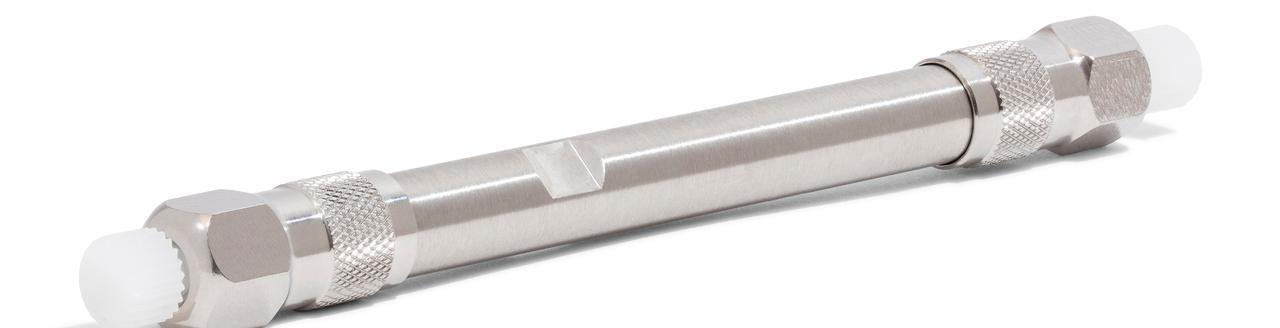
Agilent Poroshell 300 HPLC Columns
Agilent Poroshell 300 columns are engineered for fast, high-efficiency separations of intact proteins, large peptide fragments, and biomolecules. Their unique design features a 5 µm solid-core particle with a 0.25 µm, 300 Å porous shell, delivering exceptional mass transfer and sharper peaks for high-molecular-weight analytes—all while maintaining lower backpressure than comparable wide-pore fully porous particles.
The Poroshell 300 family includes multiple bonded-phase chemistries to support a wide range of biochromatography needs:
- SB-C18 — StableBond C18 for high-temperature, low-pH operation and robust peptide/protein separations.
- SB-C8 — Reduced hydrophobicity for improved recovery of large or highly hydrophobic biomolecules.
- SB-C3 — Ideal for very large proteins and mAbs that require less hydrophobic retention for optimal elution.
- Extend-C18 — High-pH stable C18 bonded phase for enhanced flexibility and method development at elevated pH.
Together, these chemistries offer powerful selectivity options for biopharmaceutical research, proteomics, aggregate analysis, and characterization of complex protein mixtures.
For additional guidance on selecting the best Poroshell 300 phase for your workflow, contact Chrom Tech for expert recommendations.
Agilent InfinityLab Poroshell 300SB-C3 is a wide-pore, low-hydrophobicity reversed-phase option designed for proteins, peptides, and other large biomolecules where 300 Å pores improve mass transfer and reduce “size exclusion” effects. The shorter C3 ligand reduces overly strong hydrophobic binding—often improving recovery and peak shape for hydrophobic proteins.
- You need wide-pore (300 Å) performance for proteins/peptides
- You want less hydrophobic retention than C8/C18 to improve recovery
- Large biomolecules show broad peaks or adsorption on more retentive phases
- You want fast separations at higher flow while maintaining efficiency
Compared to C8 and C18, C3 is the “gentlest” reversed-phase choice in this family—often reducing retention and minimizing irreversible adsorption for large, hydrophobic biomolecules.
| Separation Mode | Reversed phase (wide-pore bio separations) |
| Particle Technology | Superficially porous particle (solid core + porous shell) |
| Pore Size | 300 Å |
| Pressure Limit | 400 bar (6,000 psi) |
| pH Range | 1.0 – 8.0 (avoid <0.9 or >8.0) |
| Endcapped | No (StableBond family) |
| USP Designation | L56 |
| Temperature Guidance* | At pH < 5: up to 70 °C; at pH 5–8: up to 40 °C (best lifetime at lower temps in higher pH aqueous conditions) |
*Poroshell 300SB columns are designed for strong stability at low pH with acids like TFA/formic acid; for higher-pH method development, consider the Extend-C18 option.
Poroshell 300SB-C8 is a wide-pore bio reversed-phase phase that balances retention and recovery for peptides, proteins, and mAb subunits. C8 is often a “sweet spot” when C3 is too weakly retentive but C18 is overly sticky or slow.
- You want moderate hydrophobic retention for peptides/proteins
- C3 elutes too early or lacks resolution, but C18 over-retains
- You need a robust workhorse for bio-RP using acidic modifiers (TFA / formic)
- You want strong performance for intact and subunit workflows without excessive run times
Relative retention typically follows C18 > C8 > C3. C8 frequently improves cycle time versus C18 while keeping enough hydrophobic interaction to maintain resolution.
| Separation Mode | Reversed phase (wide-pore bio separations) |
| Particle Technology | SPP (solid core) |
| Pore Size | 300 Å |
| Pressure Limit | 400 bar (6,000 psi) |
| pH Range | 1.0 – 8.0 (avoid <0.9 or >8.0) |
| Endcapped | No (StableBond family) |
| USP Designation | L7 |
| Temperature Guidance* | At pH < 5: up to 70 °C; at pH 5–8: up to 40 °C |
*For best lifetime at higher pH aqueous conditions (near pH 6–8), use lower temperature and conservative buffer strength.
Poroshell 300SB-C18 delivers the highest hydrophobic retention in the Poroshell 300 StableBond family. It’s commonly selected when you need maximum reversed-phase interaction to resolve complex peptide maps, protein variants, or closely related biomolecules—while taking advantage of 300 Å pores and SPP efficiency for faster runs.
- You need maximum retention to resolve closely related peptide/protein species
- You’re running complex digests/peptide maps where selectivity depth matters
- C8/C3 do not provide sufficient resolution for late-eluting components
- You want high-resolution bio-RP with acidic modifiers (TFA / formic)
If resolution is limited by retention (late peaks compressed or coeluting), C18 is usually the first upgrade from C8/C3. If recovery or peak tailing becomes an issue for hydrophobic proteins, step back to C8 or C3.
| Separation Mode | Reversed phase (wide-pore bio separations) |
| Particle Technology | SPP (solid core) |
| Pore Size | 300 Å |
| Pressure Limit | 400 bar (6,000 psi) |
| pH Range | 1.0 – 8.0 (avoid <0.9 or >8.0) |
| Endcapped | No (StableBond family) |
| USP Designation | L1 |
| Temperature Guidance* | At pH < 5: up to 70 °C; at pH 5–8: up to 40 °C |
*StableBond phases are optimized for acidic conditions; for high-pH selectivity control, use Extend-C18.
Poroshell 300-Extend C18 adds a high-pH-capable C18 option to the Poroshell 300 portfolio. It uses an Extend (bidentate) silane chemistry to support method development at elevated pH—letting you manipulate analyte ionization state (and therefore selectivity and peak shape) while maintaining wide-pore, bio-friendly performance.
- You need high-pH operation (selectivity control for ionizable analytes)
- StableBond phases are not appropriate for your buffered, higher-pH conditions
- You want wide-pore C18 performance with pH-driven method development space
- You’re optimizing peak shape for basic/ionizable species by adjusting pH
Extend-C18 is the high-pH tool in this family. If you’re currently constrained to low pH (TFA/formic) and want an additional selectivity “dial,” Extend-C18 is typically the first Poroshell 300 move.
| Separation Mode | Reversed phase (wide-pore, high-pH-capable C18) |
| Particle Technology | SPP (solid core) |
| Pore Size | 300 Å |
| Pressure Limit | 400 bar (6,000 psi) |
| pH Range | Typical use: 2.0 – 11.0 (chemistry withstands up to ~11.5) |
| Endcapped | Yes |
| USP Designation | L1 |
| Temperature Limits | Up to 60 °C at ≤pH 8; up to 40 °C above pH 8 |
Practical note: for silica-based columns, longest lifetime at higher pH is typically achieved with lower temperature and conservative buffer strength.
Product List
| SKU | Name | LC Column Phase | Particle Size | Inner Diameter (ID) | Length |
|---|---|---|---|---|---|
SKU
660750-909
|
Name
660750-909 - Poroshell 300SB-C3 2.1x75mm 5u
|
LC Column Phase
300SB-C3
|
Particle Size
5 um
|
Inner Diameter (ID)
2.1 mm
|
Length
75 mm
|
SKU
820999-901
|
Name
820999-901 - High performance ZORBAX guard fittings kit
|
LC Column Phase
|
Particle Size
|
Inner Diameter (ID)
4.6 mm
|
Length
12.5 mm
|
SKU
821075-924
|
Name
821075-924 - Poroshell Guard Cartridge 300SB-C3 4/pk
|
LC Column Phase
300SB-C3
|
Particle Size
5 um
|
Inner Diameter (ID)
2.1 mm
|
Length
13 mm
|
SKU
821075-920
|
Name
821075-920 - Poroshell Guard Cartridge 300SB-C18 4/PK
|
LC Column Phase
300SB-C18
|
Particle Size
5 um
|
Inner Diameter (ID)
2.1 mm
|
Length
13 mm
|
SKU
821075-918
|
Name
821075-918 - Poroshell Guard Cartridge 300SB-C8 4/pk
|
LC Column Phase
300SB-C8
|
Particle Size
5 um
|
Inner Diameter (ID)
2.1 mm
|
Length
13 mm
|
SKU
671750-902
|
Name
671750-902 - Poroshell Extend, 1x75mm, 5 micron
|
LC Column Phase
Extend-C18
|
Particle Size
5 um
|
Inner Diameter (ID)
1 mm
|
Length
75 mm
|
SKU
670750-902
|
Name
670750-902 - Poroshell Extend, 2.1x75mm, 5 micron
|
LC Column Phase
Extend-C18
|
Particle Size
5 um
|
Inner Diameter (ID)
2.1 mm
|
Length
75 mm
|
SKU
661750-909
|
Name
661750-909 - Poroshell 300SB-C3 1x75mm 5um
|
LC Column Phase
300SB-C3
|
Particle Size
5 um
|
Inner Diameter (ID)
1 mm
|
Length
75 mm
|
SKU
661750-906
|
Name
661750-906 - Poroshell 300SB-C8 1x75mm 5u
|
LC Column Phase
300SB-C8
|
Particle Size
5 um
|
Inner Diameter (ID)
1 mm
|
Length
75 mm
|
SKU
661750-902
|
Name
661750-902 - Poroshell 300SB-C18 1x75mm 5u
|
LC Column Phase
300SB-C18
|
Particle Size
5 um
|
Inner Diameter (ID)
1 mm
|
Length
75 mm
|
SKU
660750-906
|
Name
660750-906 - Poroshell 300SB-C8 2.1x75mm 5u
|
LC Column Phase
300SB-C8
|
Particle Size
5 um
|
Inner Diameter (ID)
2.1 mm
|
Length
75 mm
|
SKU
660750-902
|
Name
660750-902 - Poroshell 300SB-C18, 2.1x75 mm, 5 micron
|
LC Column Phase
300SB-C18
|
Particle Size
5 um
|
Inner Diameter (ID)
2.1 mm
|
Length
75 mm
|