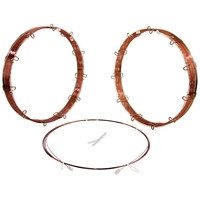
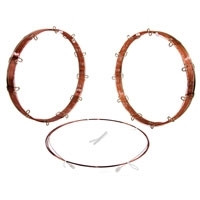
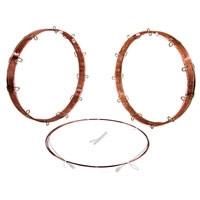
Rtx-CLPesticides

Restek Rtx-CLPesticides GC Columns
Restek Rtx-CLPesticides GC columns are engineered specifically for the analysis of organochlorine and
organophosphorus pesticides, as well as herbicides, semivolatiles, and other regulated contaminants
monitored under U.S. EPA Contract Laboratory Program (CLP) protocols. Their selectivity, inertness, and
low bleed performance make them an industry standard for laboratories running EPA methods 8081, 8082,
8270, 525, and related global pesticide workflows.
The phase chemistry is optimized to cleanly separate complex mixtures of chlorinated pesticides such as DDT and metabolites, aldrin, dieldrin, endrin, chlordane, toxaphene, and PCBs. Rtx-CLPesticides delivers exceptional resolution of these heavily regulated contaminants while maintaining robust peak shapes and stable retention times—even for challenging thermally labile compounds.
Low column bleed ensures high sensitivity and clean baselines for GC-MS, while strong inertness supports GC-ECD workflows that demand precise quantitation and minimal system contamination. The columns exhibit excellent lot-to-lot reproducibility, supporting validated and legally defensible analytical workflows for environmental, agricultural, industrial, and public health testing.
As an authorized Restek distributor, Chrom Tech supplies Rtx-CLPesticides columns in multiple dimensions tailored for high-throughput pesticide monitoring and CLP-compliant analysis of complex sample matrices.
The phase chemistry is optimized to cleanly separate complex mixtures of chlorinated pesticides such as DDT and metabolites, aldrin, dieldrin, endrin, chlordane, toxaphene, and PCBs. Rtx-CLPesticides delivers exceptional resolution of these heavily regulated contaminants while maintaining robust peak shapes and stable retention times—even for challenging thermally labile compounds.
Low column bleed ensures high sensitivity and clean baselines for GC-MS, while strong inertness supports GC-ECD workflows that demand precise quantitation and minimal system contamination. The columns exhibit excellent lot-to-lot reproducibility, supporting validated and legally defensible analytical workflows for environmental, agricultural, industrial, and public health testing.
As an authorized Restek distributor, Chrom Tech supplies Rtx-CLPesticides columns in multiple dimensions tailored for high-throughput pesticide monitoring and CLP-compliant analysis of complex sample matrices.